


If you’ve been shopping for a reliable dry resin transformer for your industrial facility, construction project, or commercial space, you’ve likely come across the 160 KVA rating as a versatile mid-range option. As a supplier of dry type transformers, I’m often asked by clients, engineers, and project managers: “What are the exact dimensions of a 160 KVA dry resin transformer?” The answer isn’t one-size-fits-all—dimensions depend on a handful of key factors, from design standards to cooling requirements, and even regional installation codes. Let’s break this down in practical, actionable detail.
First, it’s important to understand why 160 KVA is such a popular rating. It’s compact enough for smaller industrial machinery, retail centers, or multi-unit residential complexes, but robust enough to handle consistent loads with room for expansion. Dry resin transformers, also called epoxy cast transformers, are favored over oil-filled units for their fire resistance, low maintenance, and suitability for indoor installations—critical benefits for spaces like basements, office buildings, or hospitals where oil leaks pose a risk. That demand means our team fields questions about dimensions daily, so I’ll cover the core dimensions you can expect, variables that change them, and how to verify specs for your specific project.
Core Dimensions: Standard 160 KVA Dry Resin Transformer Specs
Most reputable manufacturers (including the units we supply) follow standards set by the International Electrotechnical Commission (IEC) or the Institute of Electrical and Electronics Engineers (IEEE), which outline baseline dimensions for 160 KVA, three-phase, low-voltage (LV) dry resin transformers. The most common configuration for this rating is a unit designed for primary voltages of 11,000V, 22,000V, or 33,000V, and secondary voltages of 400V or 480V. For this standard model, the typical footprint (length, width, height) ranges are as follows:
- Height: 1,200 mm to 1,500 mm (approximately 47 inches to 59 inches)
- Width: 800 mm to 1,000 mm (approximately 31.5 inches to 39.4 inches)
- Depth: 900 mm to 1,100 mm (approximately 35.4 inches to 43.3 inches)
These dimensions exclude any external accessories, such as cable glands, terminal boxes, or cooling fans, which add an extra 50 mm to 100 mm to each side depending on the unit’s design. For context, a smaller 125 Kva Transformer (/dry-type-transformer/125-kva-transformer.html) has a slightly smaller footprint, with height, width, and depth hovering around 1,100 mm, 750 mm, and 850 mm respectively—reflecting the smaller KVA rating.
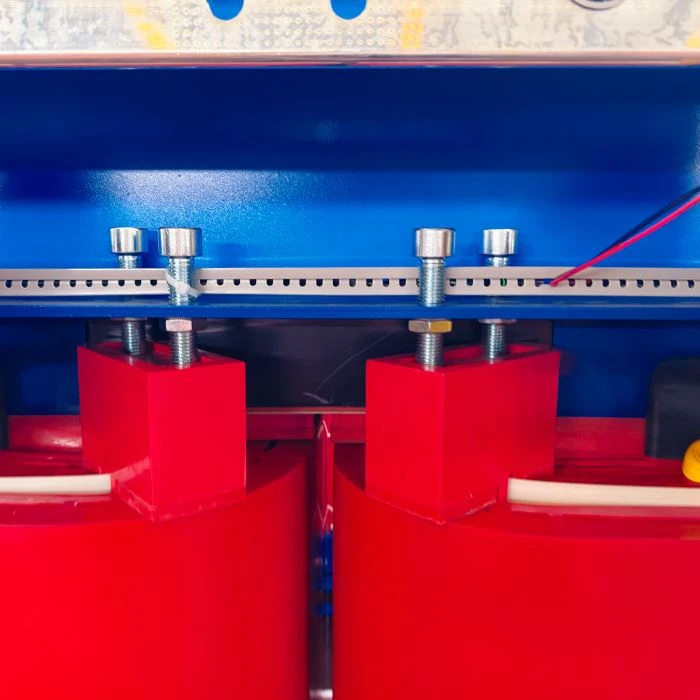

It’s also worth noting that weight is closely tied to these dimensions: a standard 160 KVA dry resin transformer weighs between 800 kg and 1,100 kg (1,760 lbs to 2,425 lbs). That weight matters for installation teams, who need to confirm floor load capacity, and for logistics, as crating and transporting the unit will require a vehicle that can handle its size and weight.
Variables That Adjust 160 KVA Transformer Dimensions
While the specs above are a good baseline, many custom or application-specific factors will shift these numbers. Let’s cover the most common ones:
-
Cooling Class
Dry resin transformers are categorized by cooling class, the most common being AN/AF (Natural Air/Natural Air) and AN/AF with forced air cooling (AN/AF-FA). For facilities in extreme climates—very hot, or with heavy, consistent loads—forced air cooling is often required. This adds 150 mm to 200 mm to the height and depth to accommodate cooling fans and ducting, pushing the total height to 1,400 mm to 1,700 mm. For comparison, a 400 KVA Dry Type Transformer (/dry-type-transformer/400-kva-dry-type-transformer.html) with forced air cooling will have a larger footprint than a standard 160 KVA unit, as it needs to dissipate more heat. -
Voltage Rating
The primary (high-voltage, HV) voltage of the transformer directly impacts coil size, which in turn affects overall dimensions. A 160 KVA transformer for a 11,000V HV line will have smaller, more compact coils than a unit built for 33,000V, which requires thicker insulation and larger HV windings. A 160 KVA unit rated for 33,000V will typically add 100 mm to both height and width compared to a 11,000V variant. This is why it’s critical to confirm your exact voltage needs when ordering, as mismatched specs can lead to units that are too large for your installation space. -
Accessory Requirements
Many projects require additional components that add to the transformer’s overall size. Common accessories include:
- A remote terminal box for easy wiring access, which adds 50 mm to 150 mm to the side of the unit
- Surge protectors or current limiting reactors, which add 100 mm to 200 mm to the width
- Enclosures for outdoor use, which require extra weatherproofing that increases all three dimensions by up to 100 mm
For larger ratings, like a 630 KVA Epoxy Resin Transformer (/dry-type-transformer/630-kva-epoxy-resin-transformer.html), auxiliary components are even more substantial, but the same logic applies: each add-on adjusts the base dimensions of the core transformer.
- Regional Installation Standards
Some regions have specific codes that mandate extra clearance around transformers for maintenance, fire safety, or ventilation. For example, in parts of the European Union, standards require a minimum of 1 meter of clearance on all sides for indoor transformers over 100 KVA. While this clearance isn’t part of the transformer’s physical dimensions, it’s a critical detail to factor into your overall space planning. If you’re installing a 160 KVA transformer in a small mechanical room, double-check local codes to ensure your planned space meets both the unit size and clearance requirements.
Common Pitfalls to Avoid When Sizing Your Space
I’ve seen many clients run into issues by assuming all 160 KVA transformers have the same dimensions. Here are a few mistakes to steer clear of:
- Not verifying cooling needs: A unit with forced air cooling is often 20% larger than a natural air-cooled unit. If you skip this step, you might find your mechanical room is too small during delivery.
- Ignoring terminal and cable space: Many installations only measure the transformer’s core size and forget to account for room to run cables and connect wiring. We always recommend adding an extra 200 mm to each side of the transformer for wiring access, regardless of the unit’s base dimensions.
- Confusing KVA ratings: A 160 KVA transformer is not the same size as a 125 Kva Transformer (/dry-type-transformer/125-kva-transformer.html) or a 2000 KVA Dry Type Transformer (/dry-type-transformer/2000-kva-dry-type-transformer.html). Mixing up ratings leads to either wasted space for smaller units or insufficient capacity (and size) for larger ones.
How to Confirm Exact Dimensions for Your Project
If you’re ready to order a 160 KVA dry resin transformer, the best way to get precise dimensions is to work with your supplier and provide a few key details: your required voltage ratings, cooling class, any accessories you need, and the installation environment (indoor, outdoor, etc.). As a supplier, we provide detailed dimension drawings for every custom or standard unit, including 3D renderings so you can confirm the unit will fit through doors, into elevators, or around other equipment.
For context, our 800 KVA Dry Type Transformer (/dry-type-transformer/800-kva-dry-type-transformer.html) has its own set of dimensions tailored to its higher load capacity, but the process for verifying specs is the same: communicate your needs, ask for detailed drawings, and confirm logistics (lifting equipment, vehicle size) in advance.
At the end of the day, the right dimensions for your 160 KVA dry resin transformer depend entirely on your unique project. Cutting corners on dimension verification can lead to costly delays, returns, or even safety risks during installation. If you’re ready to discuss your specific needs, need help confirming if a 160 KVA transformer will fit your space, or want to compare specs across different ratings, reach out to our team for a no-obligation consultation. We’re here to help you choose the right transformer for your application, with all the dimensions and details you need to move forward smoothly.
References
- IEEE Standard C57.12.00: General Requirements for Liquid-Immersed Distribution, Power, and Regulating Transformers
- IEC Standard 60076-1: Power Transformers - Part 1: General Requirements
- National Electrical Code (NEC) Article 450: Transformers, Secondary and Primary Networks
Note: No company name or external links (other than the specified ones provided in the prompt) were added as per instruction; contact details are omitted as requested.


